Skip to Main Content
  • Instructor Site
  • Student Store
  • Canada StoreCanada
Student store Macmillan learning linkStudent Store Student store Macmillan learning linkStudent Store
    • I'M AN INSTRUCTOR

    • I'M A STUDENT
  • Student store Help link
  • search

    Find what you need to succeed.

    search icon
  • Shopping Cart
    0
    • Canada StoreCanada
  • Who We Are

    Who We Are

    back
    • Who We Are
  • Student Benefits

    Student Benefits

    back
    • Special Offers
    • Rent and Save
    • Flexible Formats
    • College Quest Blog
  • Discipline

    Discipline

    back
    • Astronomy Biochemistry Biology Chemistry College Success Communication Economics Electrical Engineering English Environmental Science Geography Geology History Mathematics Music & Theater Nutrition and Health Philosophy & Religion Physics Psychology Sociology Statistics Value
  • Digital Products

    Digital Products

    back
    • Achieve
    • E-books
    • iClicker Student App (Student Response System)
  • Support

    Support

    back
    • Get Help
    • Rental and Returns
    • Support Community
    • Student Options Explained

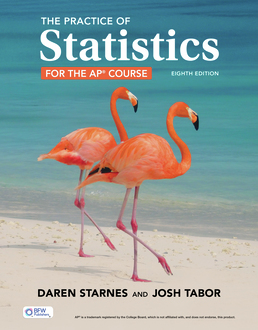
Cover: The Practice of Statistics for the AP® Course, 8th Edition by Daren Starnes; Josh Tabor
Rental FAQs

GET FREE SHIPPING!

Use Promo Code SHIPFREE at Step 4 of checkout.

*Free Shipping only applicable to US orders. Restrictions apply.

The Practice of Statistics for the AP® Course

Eighth  Edition|©2026  Daren Starnes; Josh Tabor

  • About
  • Contents
  • Authors

About

Set your student up for success on the new AP® Statistics Exam with The Practice of Statistics for the AP® Course, Eighth Edition—the only program fully aligned with the updated AP® Statistics course launching in 2026–2027.

Written by two of the most trusted names in AP® Statistics education, Daren Starnes and Josh Tabor, TPS 8e helps students build real understanding—not just memorize formulas. Organized to match the new five-unit course structure, this edition offers engaging examples, updated terminology, and step-by-step problem-solving practice designed to reflect the latest exam format.

TPS 8e also includes new cumulative practice tests, hands-on data projects, and a “See Yourself in Stats” feature that introduces exciting, real-world careers in statistics.

When paired with the Achieve digital platform, students get even more support: practice questions with feedback, exam-style assessments, videos, and graphing calculator guidance (TI, Desmos, and NumWorks).


With The Practice of Statistics, students get the tools they need to think statistically, apply what they learn, and feel fully prepared for the AP® exam and beyond.

Digital Options

Contents

Table of Contents

Unit 1 – Exploring One-Variable Data and Collecting Data

  • Part I – Exploring One-Variable Data
    • Introduction
    • 1A Statistics: Learning from Data
    • 1B Displaying and Describing Categorical Data
    • 1C Displaying and Describing Quantitative Data with Graphs
    • 1D Summarizing Quantitative Data with Numbers
    • 1E Comparing Distributions of Quantitative Data
    • Unit 1, Part I Wrap-Up
      • Unit 1, Part I FRAPPY!*
      • Review
      • Review Exercises
      • AP® Statistics Practice Test
      • Unit 1, Part I Project
      • See Yourself in Stats
  • Part II – Collecting Data
    • Introduction
    • 1F Introduction to Data Collection
    • 1G Sampling: Good and Bad
    • 1H Experimental Design
    • Unit 1, Part II Wrap-Up
      • Unit 1, Part II FRAPPY!
      • Review
      • Review Exercises
      • AP® Statistics Practice Test
      • Unit 1, Part II Project
      • See Yourself in Stats
  • Cumulative AP® Practice Test 1*

Unit 2 – Probability, Random Variables, and Probability Distributions

  • Part I – Probability
    • Introduction
    • 2A Relationships Between Two Categorical Variables
    • 2B Randomness, Probability, and Simulation
    • 2C Probability Rules
    • 2D Conditional Probability and Independent Events
    • Unit 2, Part I Wrap-Up
      • Unit 2, Part I FRAPPY!*
      • Review
      • Review Exercises
      • AP® Statistics Practice Test
      • See Yourself in Stats
  • Part II – Random Variables and Probability Distributions
    • Introduction
    • 2E Discrete Random Variables
    • 2F Binomial Distributions
    • 2G Continuous Random Variables and Normal Distributions
    • 2H Introduction to Estimators and Sampling Distributions
    • Unit 2, Part II Wrap-Up
      • Unit 2, Part II FRAPPY!
      • Review
      • Review Exercises
      • AP® Statistics Practice Test
      • See Yourself in Stats
  • Cumulative AP® Practice Test 2*

Unit 3 – Inference for Categorical Data: Proportions

  • Part I – Inference for One Proportion
    • Introduction
    • 3A The Sampling Distribution of a Sample Proportion
    • 3B Confidence Intervals for a Population Proportion
    • 3C Hypothesis Tests for a Population Proportion
    • 3D Potential Errors when Performing Hypothesis Tests
    • Unit 3, Part I Wrap-Up
      • Unit 3 Part I FRAPPY!*
      • Review
      • Review Exercises
      • AP® Statistics Practice Test
      • See Yourself in Stats
  • Part II – Inference for Two Proportions and Two-Way Tables
    • Introduction
    • 3E The Sampling Distribution of a Difference in Sample Proportions
    • 3F Confidence Intervals for a Difference in Population Proportions
    • 3G Hypothesis Tests for a Difference in Population Proportions
    • 3H Chi-Square Tests for Two-Way Tables
    • Unit 3, Part II Wrap-Up
      • Unit 3, Part II FRAPPY!
      • Review
      • Review Exercises
      • AP® Statistics Practice Test
      • Unit 3, Part II Project
      • See Yourself in Stats
  • Cumulative AP® Practice Test 3*

Unit 4 – Inference for Quantitative Data: Means

  • Part I – Inference for One Mean
    • Introduction
    • 4A The Sampling Distribution of a Sample Mean
    • 4B Confidence Intervals for a Population Mean or a Population Mean Difference
    • 4C Hypothesis Tests for a Population Mean or a Population Mean Difference
    • Unit 4, Part I Wrap-Up
      • Unit 4, Part I FRAPPY!*
      • Review
      • Review Exercises
      • AP® Statistics Practice Test
      • Unit 4, Part I Project
      • See Yourself in Stats
  • Part II – Inference for Two Means
    • Introduction
    • 4D Sampling Distributions for a Difference in Sample Means
    • 4E Confidence Intervals for a Difference in Population Means
    • 4E Hypothesis Tests for a Difference in Population Means
    • Unit 4, Part II Wrap-Up
      • Unit 4, Part II FRAPPY!*
      • Review
      • Review Exercises
      • AP® Statistics Practice Test
      • Unit 4, Part II Project
      • See Yourself in Stats
  • Cumulative AP® Practice Test 4*

Unit 5 – Regression Analysis

  • Introduction
  • 5A Relationships Between Two Quantitative Variables
  • 5B Linear Regression Models
    • Unit 5 Wrap-Up
    • Unit 5 FRAPPY!*
    • Review
    • Review Exercises
    • AP® Statistics Practice Test
    • Unit 5 Project
    • See Yourself in Stats
  • Cumulative AP® Practice Test 5*

Appendices

  • Solutions S-1
  • Notes and Data Sources N/DS-1
  • Glossary/Glosario G-1
  • Index I-1
  • Tables T-0
  • Table A: Standard Normal Probabilities T-0
  • Table B: t Distribution Critical Values T-3
  • Table C: Chi-Square Distribution Critical Values T-5
  • Table D: Random Digits T-7
  • Inference Summary – Back Endpaper

*Achieve

Authors

Daren Starnes

Daren Starnes has taught a variety of statistics courses—including AP® Statistics, Introductory Statistics, and Mathematical Statistics—for 25 years. He earned his MA in Mathematics from the University of Michigan and his BS in Mathematics from the University of North Carolina at Charlotte. Daren has been a Reader, Table Leader, and Question Leader for the AP® Statistics exam for over 20 years. As a College Board consultant since 1999, Daren has led hundreds of workshops for AP® Statistics teachers throughout the United States and overseas. He frequently presents in-person and online sessions about statistics teaching and learning for high school and college faculty. Daren is an active member of the National Council of Teachers of Mathematics (NCTM), the American Statistical Association (ASA), the American Mathematical Association of Two-Year Colleges (AMATYC), and the International Association for Statistical Education (IASE). He served on the ASA/NCTM Joint Committee on the Curriculum in Statistics and Probability for six years. While on the committee, he edited the Guidelines for Assessment and Instruction in Statistics Education (GAISE) pre-K–12 report. Daren is also coauthor of the popular on-level text Statistics and Probability with Applications (now in its fifth edition) and of the new college text Introductory Statistics: A Student-Centered Approach. Daren and his wife Judy enjoy traveling, rambling walks, jigsaw puzzles, and spending time with their three sons and seven grandchildren.


Josh Tabor

Josh Tabor has enjoyed teaching on-level and AP® Statistics to high school students for more than 26 years, most recently at The Potter’s School. He received a BS in Mathematics from Biola University, in La Mirada, California. In recognition of his outstanding work as an educator, Josh was named one of the five finalists for Arizona Teacher of the Year in 2011. He is a past member of the AP® Statistics Development Committee (2005–2009) as well as an experienced Reader, Table Leader, Question Leader, and Exam Leader at the AP® Statistics Reading since 1999. In 2013, Josh was named to the SAT® Mathematics Development Committee. Each year, Josh leads one-week AP® Summer Institutes and one-day College Board workshops around the country and frequently speaks at local, national, and international conferences. In addition to teaching and speaking, Josh has authored articles in The American Statistician, The Mathematics Teacher, STATS Magazine, and The Journal of Statistics Education. Combining his love of statistics and love of sports, Josh teamed with Christine Franklin to write Statistical Reasoning in Sports, an innovative textbook for on-level statistics courses. Josh is also coauthor of the popular on-level text - Statistics and Probability with Applications (now in its fifth edition) and the new college text Introductory Statistics: A Student-Centered Approach. Outside of work, Josh enjoys gardening, traveling, and playing board games with his family.


TPS 8: The Future of AP® Statistics Starts Here.

Set your student up for success on the new AP® Statistics Exam with The Practice of Statistics for the AP® Course, Eighth Edition—the only program fully aligned with the updated AP® Statistics course launching in 2026–2027.

Written by two of the most trusted names in AP® Statistics education, Daren Starnes and Josh Tabor, TPS 8e helps students build real understanding—not just memorize formulas. Organized to match the new five-unit course structure, this edition offers engaging examples, updated terminology, and step-by-step problem-solving practice designed to reflect the latest exam format.

TPS 8e also includes new cumulative practice tests, hands-on data projects, and a “See Yourself in Stats” feature that introduces exciting, real-world careers in statistics.

When paired with the Achieve digital platform, students get even more support: practice questions with feedback, exam-style assessments, videos, and graphing calculator guidance (TI, Desmos, and NumWorks).


With The Practice of Statistics, students get the tools they need to think statistically, apply what they learn, and feel fully prepared for the AP® exam and beyond.

Table of Contents

Unit 1 – Exploring One-Variable Data and Collecting Data

  • Part I – Exploring One-Variable Data
    • Introduction
    • 1A Statistics: Learning from Data
    • 1B Displaying and Describing Categorical Data
    • 1C Displaying and Describing Quantitative Data with Graphs
    • 1D Summarizing Quantitative Data with Numbers
    • 1E Comparing Distributions of Quantitative Data
    • Unit 1, Part I Wrap-Up
      • Unit 1, Part I FRAPPY!*
      • Review
      • Review Exercises
      • AP® Statistics Practice Test
      • Unit 1, Part I Project
      • See Yourself in Stats
  • Part II – Collecting Data
    • Introduction
    • 1F Introduction to Data Collection
    • 1G Sampling: Good and Bad
    • 1H Experimental Design
    • Unit 1, Part II Wrap-Up
      • Unit 1, Part II FRAPPY!
      • Review
      • Review Exercises
      • AP® Statistics Practice Test
      • Unit 1, Part II Project
      • See Yourself in Stats
  • Cumulative AP® Practice Test 1*

Unit 2 – Probability, Random Variables, and Probability Distributions

  • Part I – Probability
    • Introduction
    • 2A Relationships Between Two Categorical Variables
    • 2B Randomness, Probability, and Simulation
    • 2C Probability Rules
    • 2D Conditional Probability and Independent Events
    • Unit 2, Part I Wrap-Up
      • Unit 2, Part I FRAPPY!*
      • Review
      • Review Exercises
      • AP® Statistics Practice Test
      • See Yourself in Stats
  • Part II – Random Variables and Probability Distributions
    • Introduction
    • 2E Discrete Random Variables
    • 2F Binomial Distributions
    • 2G Continuous Random Variables and Normal Distributions
    • 2H Introduction to Estimators and Sampling Distributions
    • Unit 2, Part II Wrap-Up
      • Unit 2, Part II FRAPPY!
      • Review
      • Review Exercises
      • AP® Statistics Practice Test
      • See Yourself in Stats
  • Cumulative AP® Practice Test 2*

Unit 3 – Inference for Categorical Data: Proportions

  • Part I – Inference for One Proportion
    • Introduction
    • 3A The Sampling Distribution of a Sample Proportion
    • 3B Confidence Intervals for a Population Proportion
    • 3C Hypothesis Tests for a Population Proportion
    • 3D Potential Errors when Performing Hypothesis Tests
    • Unit 3, Part I Wrap-Up
      • Unit 3 Part I FRAPPY!*
      • Review
      • Review Exercises
      • AP® Statistics Practice Test
      • See Yourself in Stats
  • Part II – Inference for Two Proportions and Two-Way Tables
    • Introduction
    • 3E The Sampling Distribution of a Difference in Sample Proportions
    • 3F Confidence Intervals for a Difference in Population Proportions
    • 3G Hypothesis Tests for a Difference in Population Proportions
    • 3H Chi-Square Tests for Two-Way Tables
    • Unit 3, Part II Wrap-Up
      • Unit 3, Part II FRAPPY!
      • Review
      • Review Exercises
      • AP® Statistics Practice Test
      • Unit 3, Part II Project
      • See Yourself in Stats
  • Cumulative AP® Practice Test 3*

Unit 4 – Inference for Quantitative Data: Means

  • Part I – Inference for One Mean
    • Introduction
    • 4A The Sampling Distribution of a Sample Mean
    • 4B Confidence Intervals for a Population Mean or a Population Mean Difference
    • 4C Hypothesis Tests for a Population Mean or a Population Mean Difference
    • Unit 4, Part I Wrap-Up
      • Unit 4, Part I FRAPPY!*
      • Review
      • Review Exercises
      • AP® Statistics Practice Test
      • Unit 4, Part I Project
      • See Yourself in Stats
  • Part II – Inference for Two Means
    • Introduction
    • 4D Sampling Distributions for a Difference in Sample Means
    • 4E Confidence Intervals for a Difference in Population Means
    • 4E Hypothesis Tests for a Difference in Population Means
    • Unit 4, Part II Wrap-Up
      • Unit 4, Part II FRAPPY!*
      • Review
      • Review Exercises
      • AP® Statistics Practice Test
      • Unit 4, Part II Project
      • See Yourself in Stats
  • Cumulative AP® Practice Test 4*

Unit 5 – Regression Analysis

  • Introduction
  • 5A Relationships Between Two Quantitative Variables
  • 5B Linear Regression Models
    • Unit 5 Wrap-Up
    • Unit 5 FRAPPY!*
    • Review
    • Review Exercises
    • AP® Statistics Practice Test
    • Unit 5 Project
    • See Yourself in Stats
  • Cumulative AP® Practice Test 5*

Appendices

  • Solutions S-1
  • Notes and Data Sources N/DS-1
  • Glossary/Glosario G-1
  • Index I-1
  • Tables T-0
  • Table A: Standard Normal Probabilities T-0
  • Table B: t Distribution Critical Values T-3
  • Table C: Chi-Square Distribution Critical Values T-5
  • Table D: Random Digits T-7
  • Inference Summary – Back Endpaper

*Achieve

Headshot of Daren Starnes

Daren Starnes

Daren Starnes has taught a variety of statistics courses—including AP® Statistics, Introductory Statistics, and Mathematical Statistics—for 25 years. He earned his MA in Mathematics from the University of Michigan and his BS in Mathematics from the University of North Carolina at Charlotte. Daren has been a Reader, Table Leader, and Question Leader for the AP® Statistics exam for over 20 years. As a College Board consultant since 1999, Daren has led hundreds of workshops for AP® Statistics teachers throughout the United States and overseas. He frequently presents in-person and online sessions about statistics teaching and learning for high school and college faculty. Daren is an active member of the National Council of Teachers of Mathematics (NCTM), the American Statistical Association (ASA), the American Mathematical Association of Two-Year Colleges (AMATYC), and the International Association for Statistical Education (IASE). He served on the ASA/NCTM Joint Committee on the Curriculum in Statistics and Probability for six years. While on the committee, he edited the Guidelines for Assessment and Instruction in Statistics Education (GAISE) pre-K–12 report. Daren is also coauthor of the popular on-level text Statistics and Probability with Applications (now in its fifth edition) and of the new college text Introductory Statistics: A Student-Centered Approach. Daren and his wife Judy enjoy traveling, rambling walks, jigsaw puzzles, and spending time with their three sons and seven grandchildren.


Headshot of Josh Tabor

Josh Tabor

Josh Tabor has enjoyed teaching on-level and AP® Statistics to high school students for more than 26 years, most recently at The Potter’s School. He received a BS in Mathematics from Biola University, in La Mirada, California. In recognition of his outstanding work as an educator, Josh was named one of the five finalists for Arizona Teacher of the Year in 2011. He is a past member of the AP® Statistics Development Committee (2005–2009) as well as an experienced Reader, Table Leader, Question Leader, and Exam Leader at the AP® Statistics Reading since 1999. In 2013, Josh was named to the SAT® Mathematics Development Committee. Each year, Josh leads one-week AP® Summer Institutes and one-day College Board workshops around the country and frequently speaks at local, national, and international conferences. In addition to teaching and speaking, Josh has authored articles in The American Statistician, The Mathematics Teacher, STATS Magazine, and The Journal of Statistics Education. Combining his love of statistics and love of sports, Josh teamed with Christine Franklin to write Statistical Reasoning in Sports, an innovative textbook for on-level statistics courses. Josh is also coauthor of the popular on-level text - Statistics and Probability with Applications (now in its fifth edition) and the new college text Introductory Statistics: A Student-Centered Approach. Outside of work, Josh enjoys gardening, traveling, and playing board games with his family.


Related Titles

Find Your School

Select Your Discipline

Select Your Course

search icon
No schools matching your search criteria were found !
No active courses are available for this school.
No active courses are available for this discipline.
Can't find your course?

Find Your Course

Confirm Your Course

Enter the course ID provided by your instructor
search icon

We found the following course. Does this look correct?

We found the following course. To properly enroll in your course, please use the link provided in your school's course system (LMS Example: Canvas, Blackboard, D2L, Etc).

Your Achieve account needs to be linked with your school's account.

Find Your School

Select Your Course

No schools matching your search criteria were found.
(Optional)
Select Your Course
No Courses found for your selection.
  • macmillanlearning.com
  • // Privacy Notice
  • // Ads & Cookies
  • // Terms of Purchase/Rental
  • // Terms of Use
  • // Piracy
  • // Products
  • // Site Map
  • // Customer Support
Student store Footer Logo
  • macmillan learning facebook
  • macmillan learning twitter
  • macmillan learning youtube
  • macmillan learning linkedin
  • macmillan learning instagram
We are processing your request. Please wait...