 United States


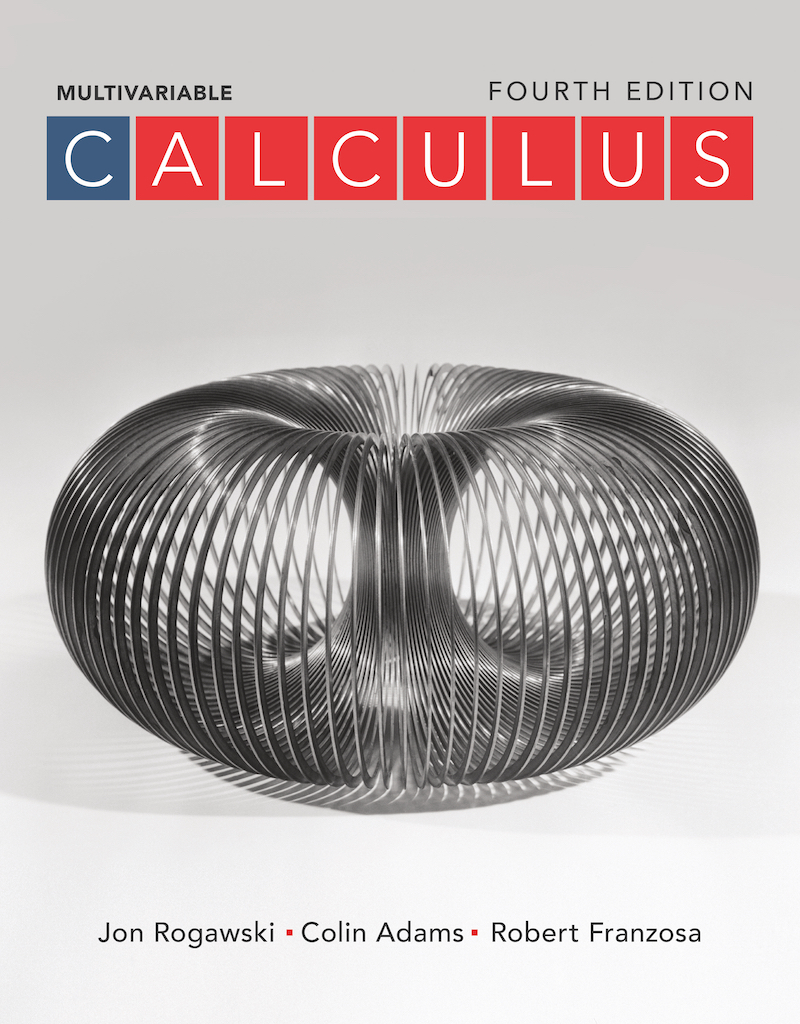
Calculus: Late Transcendentals Multivariable


Fourth Edition©2019 Jon Rogawski; Colin Adams; Robert Franzosa
ISBN:9781319281953
Take notes, add highlights, and download our mobile-friendly e-books.
We see teaching mathematics as a form of story-telling, both when we present in a classroom and when we write materials for exploration and learning. The goal is to explain to you in a captivating manner, at the right pace, and in as clear a way as possible, how mathematics works and what it can do for you. We find mathematics to be intriguing and immensely beautiful. We want you to feel that way, too.
E-book
Read online (or offline) with all the highlighting and notetaking tools you need to be successful in this course.
Learn MoreTable of Contents
Chapter 1: Precalculus Review
1.1 Real Numbers, Functions, and Graphs
1.2 Linear and Quadratic Functions
1.3 The Basic Classes of Functions
1.4 Trigonometric Functions
1.5 Inverse Functions
1.6 Exponential and Logarithmic Functions
1.7 Technology: Calculators and Computers
Chapter 2: Limits
2.1 The Limit Idea: Instantaneous Velocity and Tangent Lines
2.2 Investigating Limits
2.3 Basic Limit Laws
2.4 Limits and Continuity
2.5 Indeterminate Forms
2.6 The Squeeze Theorem and Trigonometric Limits
2.7 Limits at Infinity
2.8 The Intermediate Value Theorem
2.9 The Formal Definition of a Limit
Chapter 3: Differentiation
3.1 Definition of the Derivative
3.2 The Derivative as a Function
3.3 Product and Quotient Rules
3.4 Rates of Change
3.5 Higher Derivatives
3.6 Trigonometric Functions
3.7 The Chain Rule
3.8 Implicit Differentiation
3.9 Derivatives of General Exponential and Logarithmic Functions
3.10 Related Rates
Chapter 4: Applications of the Derivative
4.1 Linear Approximation and Applications
4.2 Extreme Values
4.3 The Mean Value Theorem and Monotonicity
4.4 The Second Derivative and Concavity
4.5 L’Hôpital’s Rule
4.6 Analyzing and Sketching Graphs of Functions
4.7 Applied Optimization
4.8 Newton’s Method
Chapter 5: Integration
5.1 Approximating and Computing Area
5.2 The Definite Integral
5.3 The Indefinite Integral
5.4 The Fundamental Theorem of Calculus, Part I
5.5 The Fundamental Theorem of Calculus, Part II
5.6 Net Change as the Integral of a Rate of Change
5.7 The Substitution Method
5.8 Further Integral Formulas
Chapter 6: Applications of the Integral
6.1 Area Between Two Curves
6.2 Setting Up Integrals: Volume, Density, Average Value
6.3 Volumes of Revolution: Disks and Washers
6.4 Volumes of Revolution: Cylindrical Shells
6.5 Work and Energy
Chapter 7: Techniques of Integration
7.1 Integration by Parts
7.2 Trigonometric Integrals
7.3 Trigonometric Substitution
7.4 Integrals Involving Hyperbolic and Inverse Hyperbolic Functions
7.5 The Method of Partial Fractions
7.6 Strategies for Integration
7.7 Improper Integrals
7.8 Numerical Integration
Chapter 8: Further Applications of the Integral
8.1 Probability and Integration
8.2 Arc Length and Surface Area
8.3 Fluid Pressure and Force
8.4 Center of Mass
Chapter 9: Introduction to Differential Equations
9.1 Solving Differential Equations
9.2 Models Involving y=k(y-b)
9.3 Graphical and Numerical Methods
9.4 The Logistic Equation
9.5 First-Order Linear Equations
Chapter 10: Infinite Series
10.1 Sequences
10.2 Summing an Infinite Series
10.3 Convergence of Series with Positive Terms
10.4 Absolute and Conditional Convergence
10.5 The Ratio and Root Tests and Strategies for Choosing Tests
10.6 Power Series
10.7 Taylor Polynomials
10.8 Taylor Series
Chapter 11: Infinite Series
11.1 Sequences
11.2 Summing an Infinite Series
11.3 Convergence of Series with Positive Terms
11.4 Absolute and Conditional Convergence
11.5 The Ratio and Root Tests and Strategies for Choosing Tests
11.6 Power Series
11.7 Taylor Polynomials
11.8 Taylor Series
Chapter 12: Parametric Equations, Polar Coordinates, and Conic Sections
12.1 Parametric Equations
12.2 Arc Length and Speed
12.3 Polar Coordinates
12.4 Area and Arc Length in Polar Coordinates
12.5 Conic Sections
Chapter 13: Vector Geometry
13.1 Vectors in the Plane
13.2 Three-Dimensional Space: Surfaces, Vectors, and Curves
13.3 Dot Product and the Angle Between two Vectors
13.4 The Cross Product
13.5 Planes in 3-Space
13.6 A Survey of Quadric Surfaces
13.7 Cylindrical and Spherical Coordinates
Chapter 14: Calculus of Vector-Valued Functions
14.1 Vector-Valued Functions
14.2 Calculus of Vector-Valued Functions
14.3 Arc Length and Speed
14.4 Curvature
14.5 Motion in 3-Space
14.6 Planetary Motion According to Kepler and Newton
Chapter 15: Differentiation in Several Variables
15.1 Functions of Two or More Variables
15.2 Limits and Continuity in Several Variables
15.3 Partial Derivatives
15.4 Differentiability, Tangent Planes, and Linear Approximation
15.5 The Gradient and Directional Derivatives
15.6 Multivariable Calculus Chain Rules
15.7 Optimization in Several Variables
15.8 Lagrange Multipliers: Optimizing with a Constraint
Chapter 16: Multiple Integration
16.1 Integration in Two Variables
16.2 Double Integrals over More General Regions
16.3 Triple Integrals
16.4 Integration in Polar, Cylindrical, and Spherical Coordinates
16.5 Application of Multiple Integrals
16.6 Change of Variables
Chapter 17: Line and Surface Integrals
17.1 Vector Fields
17.2 Line Integrals
17.3 Conservative Vector Fields
17.4 Parametrized Surfaces and Surface Integrals
17.5 Surface Integrals of Vector Fields
Chapter 18: Fundamental Theorems of Vector Analysis
18.1 Green’s Theorem
18.2 Stokes’ Theorem
18.3 Divergence Theorem

Jon Rogawski
Jon Rogawski received his undergraduate and master’s degrees in mathematics simultaneously from Yale University, and he earned his PhD in mathematics from Princeton University, where he studied under Robert Langlands. Before joining the Department of Mathematics at UCLA in 1986, where he was a full professor, he held teaching and visiting positions at the Institute for Advanced Study, the University of Bonn, and the University of Paris at Jussieu and Orsay. Jon’s areas of interest were number theory, automorphic forms, and harmonic analysis on semisimple groups. He published numerous research articles in leading mathematics journals, including the research monograph Automorphic Representations of Unitary Groups in Three Variables (Princeton University Press). He was the recipient of a Sloan Fellowship and an editor of the Pacific Journal of Mathematics and the Transactions of the AMS. As a successful teacher for more than 30 years, Jon Rogawski listened and learned much from his own students. These valuable lessons made an impact on his thinking, his writing, and his shaping of a calculus text. Sadly, Jon Rogawski passed away in September 2011. Jon’s commitment to presenting the beauty of calculus and the important role it plays in students’ understanding of the wider world is the legacy that lives on in each new edition of Calculus.

Colin Adams
Colin Adams is the Thomas T. Read professor of Mathematics at Williams College, where he has taught since 1985. Colin received his undergraduate degree from MIT and his PhD from the University of Wisconsin. His research is in the area of knot theory and low-dimensional topology. He has held various grants to support his research, and written numerous research articles. Colin is the author or co-author of The Knot Book, How to Ace Calculus: The Streetwise Guide, How to Ace the Rest of Calculus: The Streetwise Guide, Riot at the Calc Exam and Other Mathematically Bent Stories, Why Knot?, Introduction to Topology: Pure and Applied, and Zombies & Calculus. He co-wrote and appears in the videos “The Great Pi vs. E Debate” and “Derivative vs. Integral: the Final Smackdown.” He is a recipient of the Haimo National Distinguished Teaching Award from the Mathematical Association of America (MAA) in 1998, an MAA Polya Lecturer for 1998-2000, a Sigma Xi Distinguished Lecturer for 2000-2002, and the recipient of the Robert Foster Cherry Teaching Award in 2003. Colin has two children and one slightly crazy dog, who is great at providing the entertainment.

Robert Franzosa
Robert (Bob) Franzosa is a professor of mathematics at the University of Maine where he has been on the faculty since 1983. Bob received a BS in mathematics from MIT in 1977 and a Ph.D. in mathematics from the University of Wisconsin in 1984. His research has been in dynamical systems and in applications of topology in geographic information systems. He has been involved in mathematics education outreach in the state of Maine for most of his career. Bob is a co-author of Introduction to Topology: Pure and Applied and Algebraic Models in Our World. He was awarded the University of Maine’s Presidential Outstanding Teaching award in 2003. Bob is married, has two children, three step-children, and one recently-arrived grandson.
Find Your School
Select Your Discipline
Select Your Course

Find Your Course
Confirm Your Course